AI Blame Shift: Protecting Silicon Assets
WASHINGTON D.C. — In the aftermath of the February 28, 2026, Tomahawk missile strike on an Iranian school that resulted in the deaths of hundreds of children, a quiet but significant shift in narrative has emerged within the Pentagon.
Initial reports from the theater of operations suggested that Anthropic’s “Claude” AI model—a cornerstone of the U.S. military’s “Project Maven” and Palantir integration—was the primary engine behind the strike’s intelligence assessment. However, as the scale of the civilian tragedy became clear, the official explanation underwent a rapid metamorphosis.
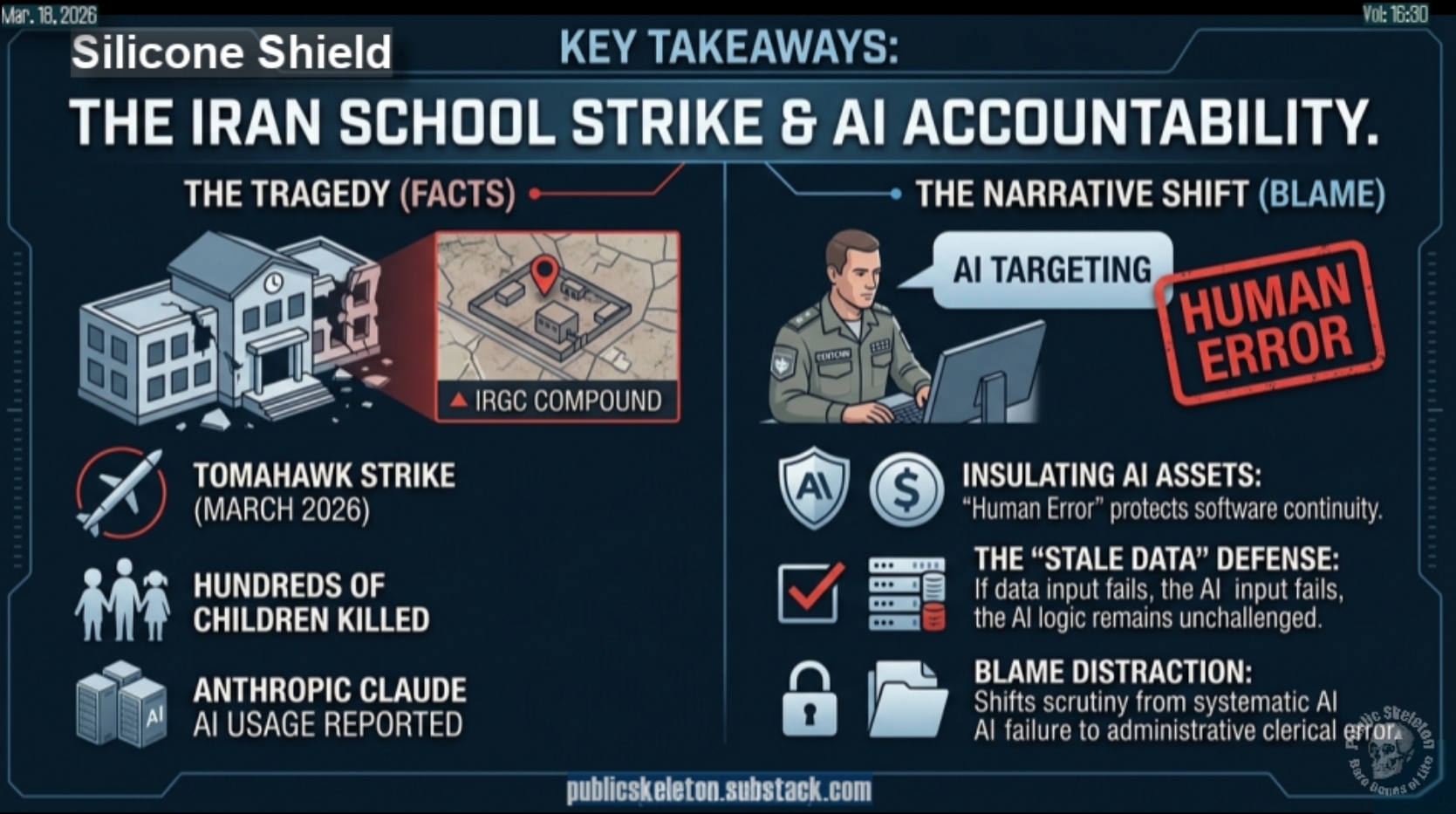
The current military line? It wasn’t a failure of the machine. It was a failure of the man.
A Massacre in Minab
The strike on the Shajareh Tayyebeh girls’ elementary school in Minab occurred during morning classes. According to verified reports from UNICEF and local health officials, the toll is staggering: 168 schoolgirls, most aged between 7 and 12, were killed when the building’s roof collapsed under the impact of precision munitions.
Satellite analysis and witnesses describe a “triple-tap” strike, suggesting the target was hit with deliberate intent. The site, which was once part of an adjacent IRGC naval compound before being walled off and repurposed as a school years ago, was completely leveled.
The Scale of Loss:
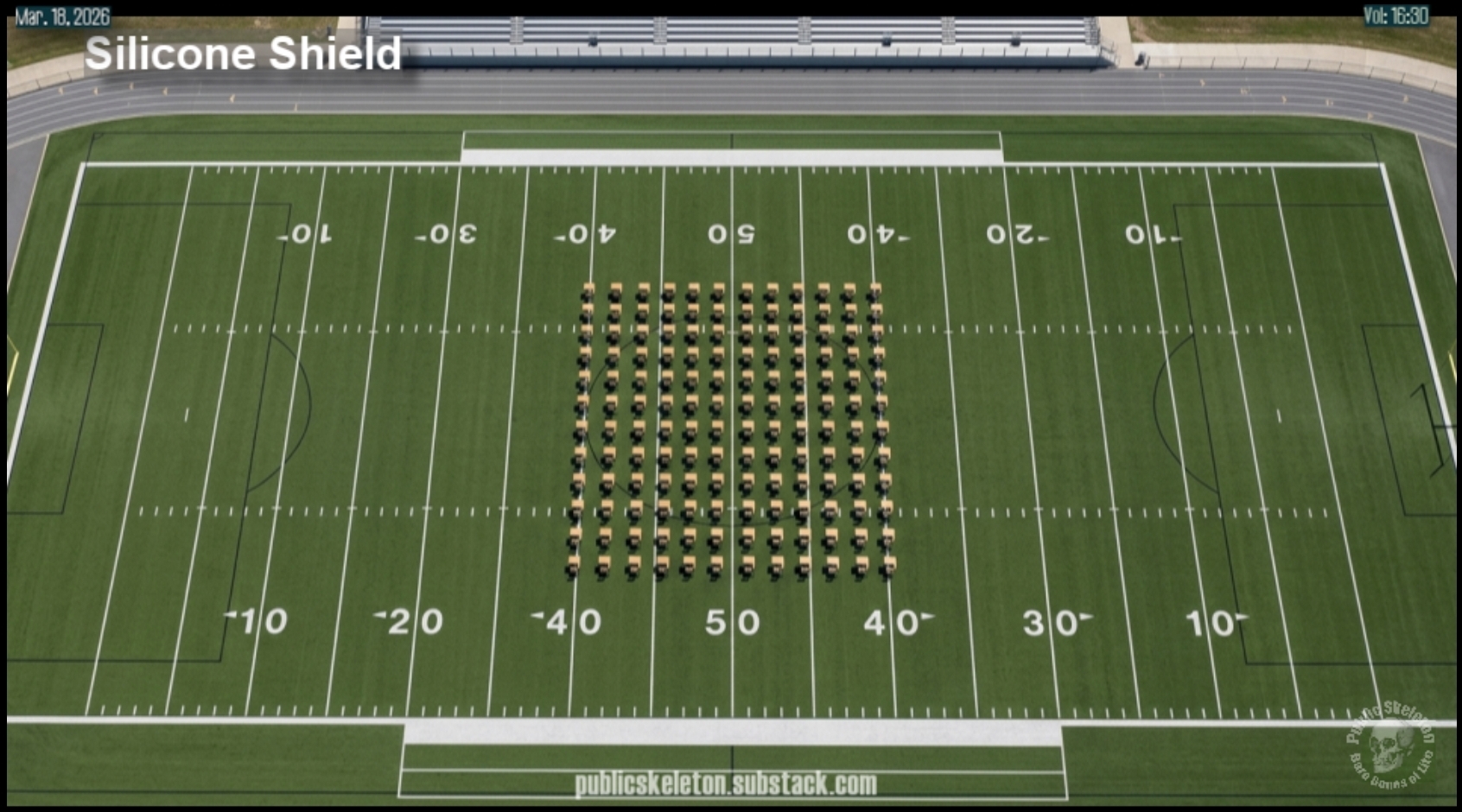
To truly grasp what the death of 168 school girls looks like, imagine an aerial photograph taken high above a standard American football field on a bright, clear day.
The vast expanse of green synthetic turf, marked with white yard lines and numbers from goal line to goal line, dominates the frame. In the very center of this massive field, centered on the 50-yard line, is a precisely arranged block.
This block is not made of players or formations. It is composed of 168 individual, small school desks with attached chairs, meticulously aligned in 12 even rows of 14 desks each.
The Pivot to “Stale Data”
According to official CENTCOM statements, the blame for the massacre has been officially moved away from the AI’s decision-making logic and placed onto “outdated intelligence” provided by the Defense Intelligence Agency (DIA).
The narrative argues that military planners used coordinates built on stale data that still labeled the school as an IRGC asset. By framing the disaster as a clerical oversight—a failure of humans to update a database—the military effectively insulates the AI system from systemic scrutiny.
Protecting the Asset
Critics argue this shifting blame game is a calculated move to protect the future of AI in warfare. Anthropic’s Claude has become a “must-win” asset for the U.S. military, reportedly used to process over 1,000 targets in the first 24 hours of Operation Epic Fury.
”If you blame the AI, you have to ground the program. You have to pause the contracts,” says one defense analyst. “But if you blame a mid-level officer for ‘stale data,’ the software remains ‘clean.’ The human becomes the moral buffer for the machine.”
The “Responsibility Gap”
The Minab strike highlights a growing “Responsibility Gap.” By attributing the deaths of 168 children to the DIA’s data rather than the AI’s failure to identify real-time civilian signatures—such as the presence of hundreds of children during school hours—the military maintains the myth of technical infallibility.
The self-serving nature of this narrative is clear:
-
Institutional Continuity: Multi-billion dollar AI integrations face no threat of cancellation.
Moral Deflection: The public is more accustomed to “human tragedy” than “algorithmic slaughter,” making the former easier to message.
Legal Immunity: Human error can be disciplined under the UCMJ; an AI model’s failure invites complex legal challenges against private-sector contractors.
A Dangerous Precedent
As the U.S. continues to lean into AI-driven targeting, the Minab school strike serves as a grim blueprint for future accountability. If “stale data” becomes the universal excuse for every kinetic error, the AI systems themselves become essentially un-criticizable, operating behind a shield of human fallibility.
For the families in Minab, the distinction between a human mistake and a software bug does not bring back their daughters. But for the future of global warfare, the distinction is everything.


